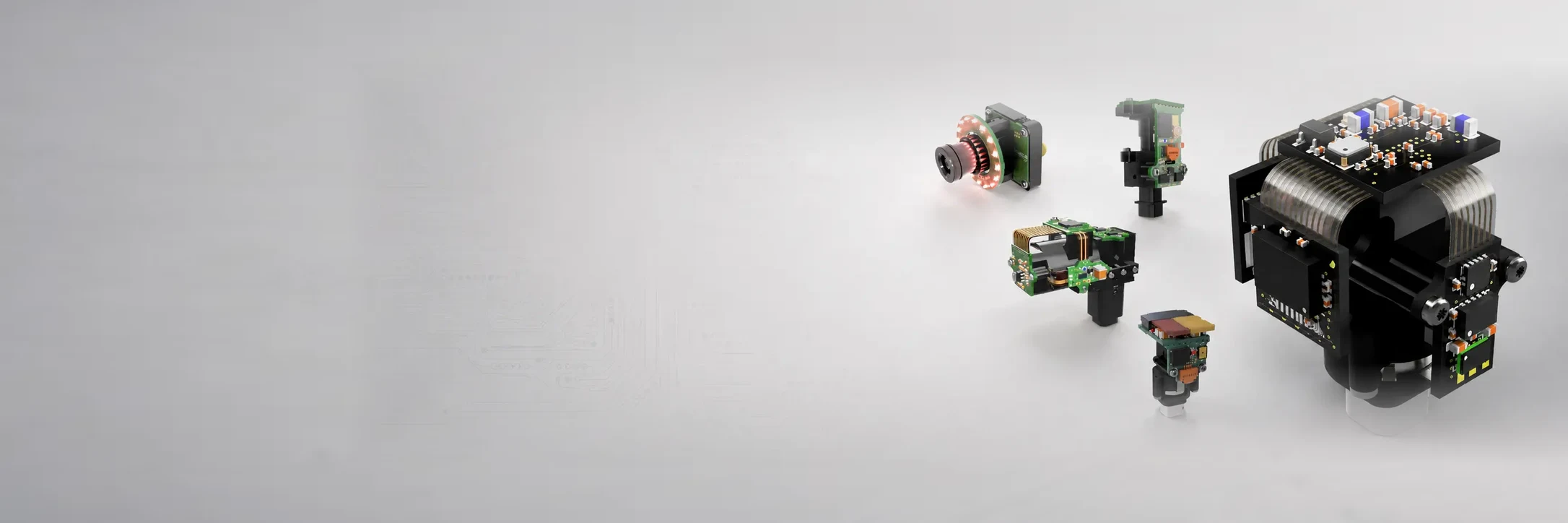
UCLA Miniscope Project
News and updates from the UCLA Miniscope Project and the wider Miniscope community.


Introducing the new Miniscope wiki
The miniscope.org wiki is now the main home for the UCLA Miniscope Project. Anyone can read it, and with an account you can ask questions on the forum or contribute content. The old wiki will remain online while we continue moving material over.
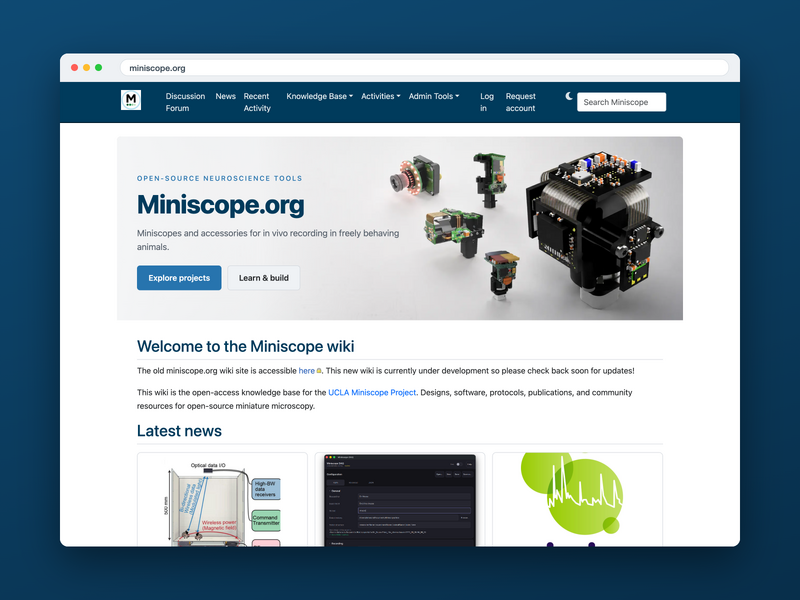
- Projects Miniscope designs, software, build info, and publications.
- Guides Step-by-step instructions and troubleshooting.
- Experiment Registry A searchable collection of published Miniscope preparations.
- FAQs Answers to common questions.
- Events & Office hours Upcoming workshops and biweekly drop-ins.
- Publications Papers using Miniscopes.
Preprint: Miniscope Zero, fully wireless calcium imaging
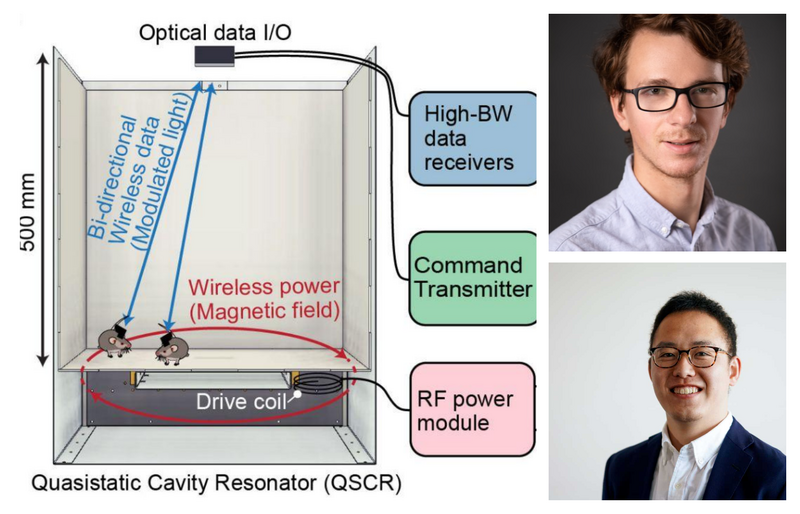
Congratulations to Takuya Sasatani, PhD and Marcel Brosch, PhD on their preprint describing Miniscope Zero, a one-photon calcium-imaging platform with no data tether and no power tether. It combines wide-area wireless power based on quasistatic cavity resonance (QSCR) with a high-bandwidth optical data link, supporting real-time cellular-resolution imaging in freely behaving mice.
Miniscope DAQ Software v2.0
On 1 August, we released version 2.0 of Miniscope DAQ Software, the desktop app used to configure, stream, and record from Miniscopes and behavior cameras. This is the largest update to the software so far, with ready-to-run versions for Windows, Linux, and macOS. Thanks to Federico Sangiuliano for leading this work.
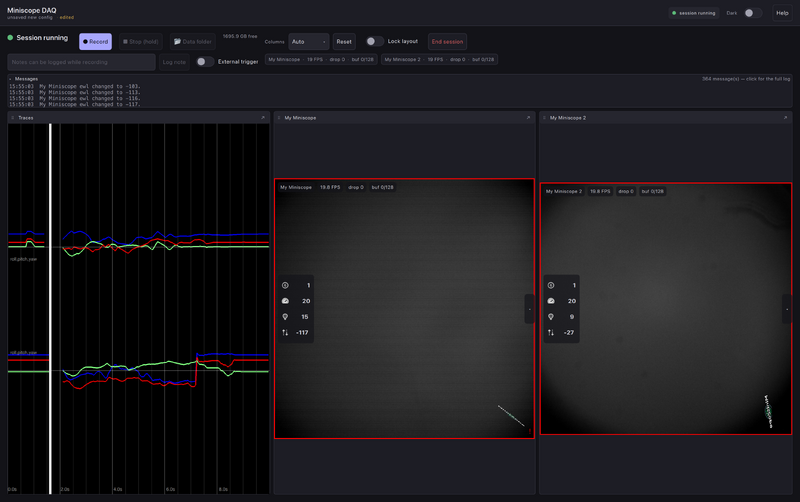
- Setup and acquisition in one window, with a form-based configuration editor
- Recording errors reported clearly; stops safely when disk space runs low
- DAQ frame numbers in
timeStamps.csv, so dropped frames can be found - Built-in Open Ephys commutator control from the V4's orientation sensor
2026 workshop recap
This summer, we brought hands-on Miniscope training to Paris, Cold Spring Harbor Laboratory, and Research Triangle, NC, reaching more than 50 researchers from around the world.
Paris was co-hosted with Gisella Vetere's lab at ESPCI Paris and Denise Cai and Tristan Shuman's group at Mount Sinai, with an evening Miniscope build led by Open Ephys Production Site. Special thanks to Austin Baggetta, who helped plan the workshop, performed the surgeries, and taught many sessions.
At CSHL, we baseplated an animal on site for the first time, and students used the V4 in their final projects to image odor responses in the olfactory bulb.
Research Triangle, co-hosted with Jesse Cushman at NIEHS, focused on data analysis with 32 participants from across North Carolina and beyond.
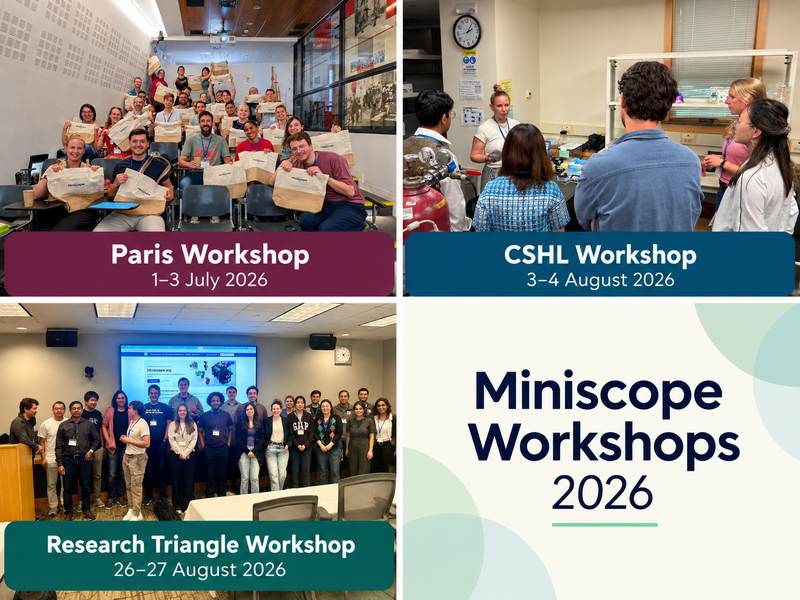
- Paris Workshop July 1–3, 2026
- CSHL Workshop August 3–4, 2026
- Research Triangle Workshop August 26–27, 2026
Recent questions, answered
We're moving community discussion from the Google Group to the wiki forum. Ask a question, share your experience, or help others in the community.
Get involved
Join the mailing list, attend an event, or contribute content to the wiki.
- Miniscope use survey Help us understand how Miniscope users work and what to prioritize.
- Drop-in office hours Every other Friday, 10–11 AM Pacific, on Zoom. Next: October 2.
- Upcoming events Workshops, talks, and training.
Talk: before the page name in the address bar (for example, miniscope.org/wiki/Talk:Miniscope_V4).